Residential fire sprinkler systems require careful design and manufacturer catalog evaluations, where maximum coverage area depends directly on available hydraulic pressure. Selecting exact drop locations demands careful routing of piping distribution and a strict application of NFPA 13 obstruction rules to avoid the costly over-deployment of unnecessary sprinklers.
Introduction to Residential Fire Sprinkler Design
Residential fire sprinklers serve as the primary defensive line for safeguarding residential occupancies. Engineered with fast-response thermal elements and distinct high wall-wetting characteristics, they deliver exceptional performance compared to standard spray sprinklers.
This comprehensive technical guide outlines the step-by-step design of a fire sprinkler layout for a multi-room residential suite. The design criteria, calculations, and spacing optimizations detailed below strictly comply with the NFPA 13 (2016 Edition) standard.
Part 1: Hydrological Dynamics & Coverage Area Requirements
The Relationship Between Pressure and Coverage Spacing
A fundamental engineering difference between residential fire sprinklers and commercial alternatives (such as standard spray, Control Mode Specific Application [CMSA], or Early Suppression Fast Response [ESFR] types) is that residential sprinkler coverage areas depend directly on the available operating pressure.
Per NFPA 13, Section 8.10.2.1, the maximum coverage area and corresponding minimum flow and pressure must be chosen strictly in accordance with the manufacturer's specific listing and datasheet.
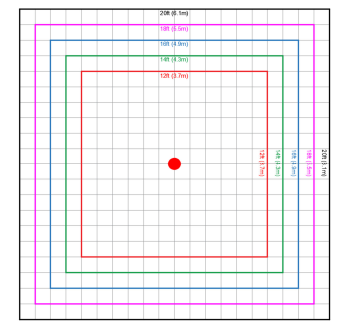
Model PND100: Hydraulic Coverage and Pressure Listing
To demonstrate this hydraulic relationship, consider a listed residential pendent sprinkler Model PND100. The table below highlights how increasing the baseline pressure changes the listed maximum coverage geometry:
| Maximum Coverage Area | Minimum Required Pressure (psi) | Minimum Required Pressure (bar) |
|---|---|---|
| 12 ft × 12 ft (3.7 m × 3.7 m) | 7 psi | 0.5 bar |
| 14 ft × 14 ft (4.3 m × 4.3 m) | 9 psi | 0.62 bar |
| 16 ft × 16 ft (4.9 m × 4.9 m) | 11 psi | 0.76 bar |
| 18 ft × 18 ft (5.5 m × 5.5 m) | 14 psi | 0.90 bar |
| 20 ft × 20 ft (6.1 m × 6.1 m) | 17 psi | 1.17 bar |
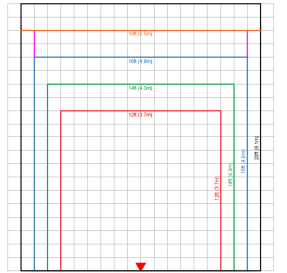
Model SW200: Residential Sidewall Sprinkler Hydraulic Listing
Alternatively, we look at a listed residential sidewall sprinkler, Model SW200, which features a strict limitation specifying a maximum distance between the deflector and the ceiling of 150 mm (6 inches):
| Maximum Coverage Area | Minimum Required Pressure (psi) | Minimum Required Pressure (bar) |
|---|---|---|
| 12 ft × 12 ft (3.7 m × 3.7 m) | 9 psi | 0.62 bar |
| 14 ft × 14 ft (4.3 m × 4.3 m) | 11 psi | 0.76 bar |
| 16 ft × 16 ft (4.9 m × 4.9 m) | 13 psi | 0.89 bar |
| 16 ft × 18 ft (4.9 m × 5.5 m) | 18 psi | 1.24 bar |
| 18 ft × 18 ft (5.5 m × 5.5 m) | 28 psi | 1.93 bar |
| 18 ft × 20 ft (5.5 m × 6.1 m) | 35 psi | 2.41 bar |
Part 2: Spatial Architecture & Piping Infrastructure
Balancing Architectural Aesthetics and Piping Distribution Routes
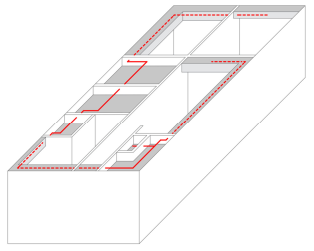
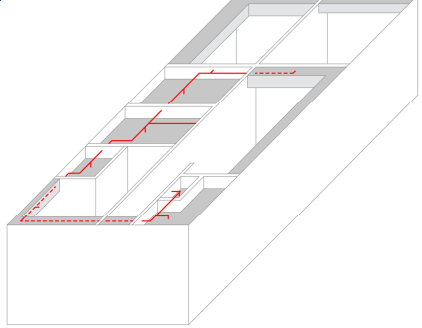
Before identifying exact sprinkler drop locations, a comprehensive architectural spatial analysis must determine optimal routing for the fire sprinkler pipe network. To preserve building aesthetics and prevent exposed pipe runs, distribution networks must be concealed above suspended ceilings or routed inside architectural soffits wherever feasible.
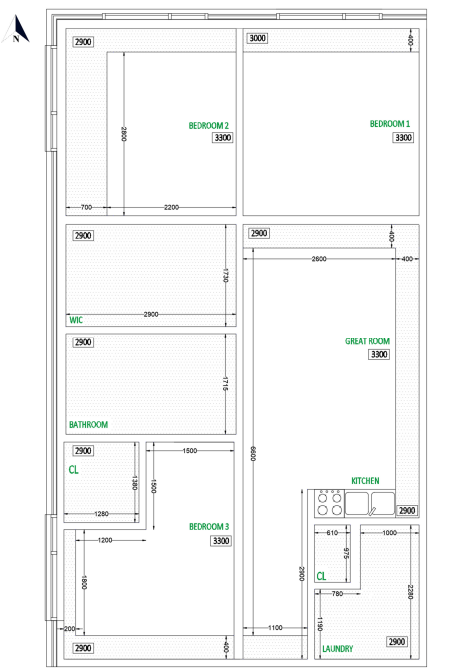
An evaluation of Bedroom 1 via section views reveals a solid ceiling with no suspended assembly. Dropping an exposed pipe and pendent head directly underneath the structural ceiling is rejected for aesthetic reasons.
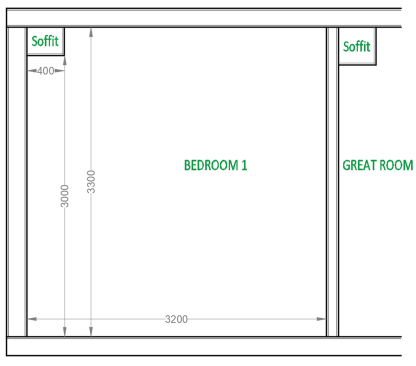
Two alternative piping routes are available for Bedroom 1:
- Route the branch line internally through the northern structural soffit built within Bedroom 1.
- Route the branch line through the northern soffit of the adjacent Great Room, penetrate through the common wall into Bedroom 1, and mount a sidewall head.
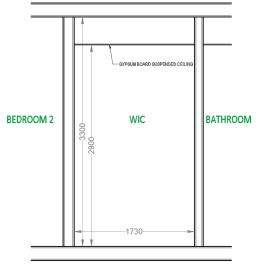
In contrast, the Walk-In Closet (WIC) features a gypsum board suspended ceiling system. This allows the distribution piping to run hidden in the plenum space above the ceiling, dropping down to a standard concealed pendent sprinkler head.
Part 3: Step-by-Step Room Layout Optimization & Compliance
Sprinkler Placement Calculations for Bedroom 1
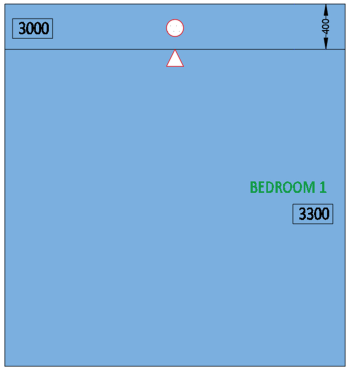
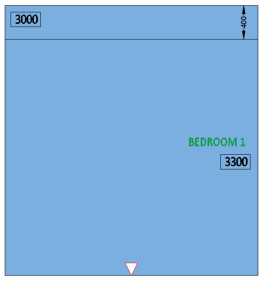
Bedroom 1 features a perimeter soffit along its northern wall situated at an elevation of 3000 mm above the finished floor line (AFF), while the main ceiling sits at 3300 mm AFF. We analyze three engineering installation options for this space:
Option 1: Mounting a Sidewall Sprinkler on the Vertical Face of the North Soffit
Positioning the sidewall head on the vertical face of the soffit throws water across the open room. However, the area directly beneath the 400 mm wide soffit (behind the head) is shielded from the spray pattern.
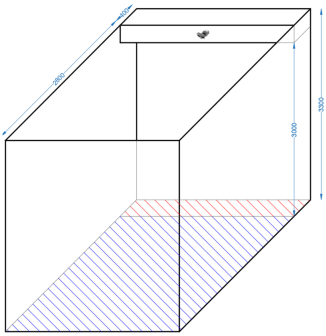
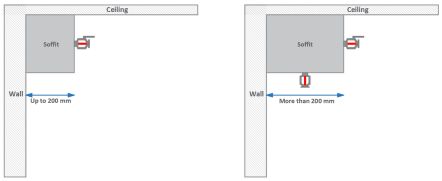
To resolve this, we apply NFPA 13, Section 8.10.7.1.5.1. When a residential sidewall sprinkler is mounted on the face of a soffit or beam, and the width of that obstruction exceeds 200 mm (8 inches), a separate pendent sprinkler must be installed underneath the soffit. Because the north soffit has a width of 400 mm, Option 1 requires two sprinkler heads—one sidewall head on the face and an additional pendent head underneath the soffit track.
Option 2: Mounting a Sidewall Sprinkler on the South Wall Throwing Northward
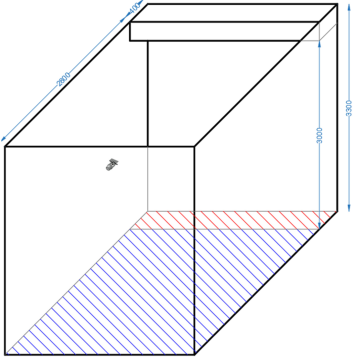
In this scenario, the branch line runs through the Great Room's soffit and penetrates the south wall of Bedroom 1. The 400 mm wide, 300 mm deep north soffit now acts as a potential obstruction located across the room in front of the head.
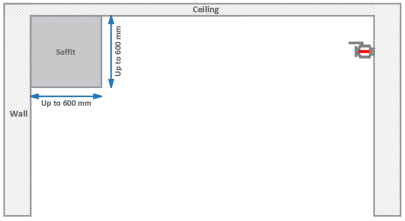
Where a soffit configuration runs flat against a wall, NFPA 13 permits the application of the Soffit Rule. Per Section 8.10.7.1.6 and Figure A.8.10.7.1.6, if a soffit's total width and total depth do not exceed 600 mm (24 inches), it does not constitute a spray obstruction.
Structural Dimensions Evaluation:
- Soffit Width = 400 mm ≤ 600 mm
- Soffit Depth = 300 mm ≤ 600 mm
Because both metrics fall below the 600 mm maximum threshold, the soffit is mathematically ignored as an obstruction. The sidewall sprinkler mounted on the south wall successfully protects the entire room, including the space underneath the far soffit, using only one sprinkler head.
Option 3: Applying the Ceiling Pocket Rule
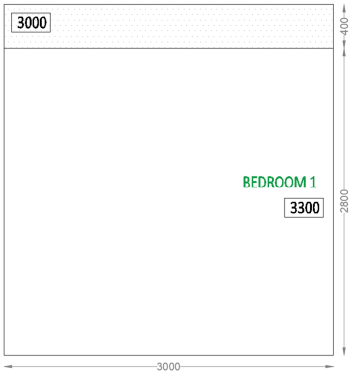
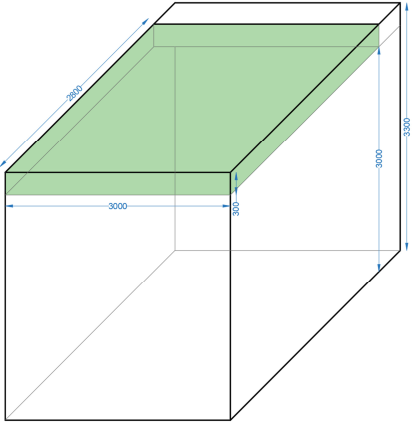
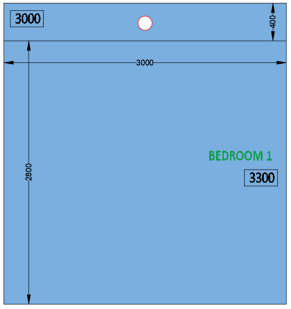
The soffit's 300 mm drop forms a recessed area or ceiling pocket across the room. We calculate the pocket's architectural parameters:
- Pocket Depth = Ceiling Height - Soffit Height = 3300 mm - 3000 mm = 300 mm
- Pocket Volume = 3.0 m × 2.8 m × 0.3 m = 2.52 m³
Under NFPA 13, Section 8.10.8, a ceiling pocket can be protected exclusively by a single pendent head mounted underneath the adjacent soffit drop, provided the maximum depth does not exceed 300 mm, the pocket volume does not exceed 2.8 m³, and the interior surfaces are noncombustible.
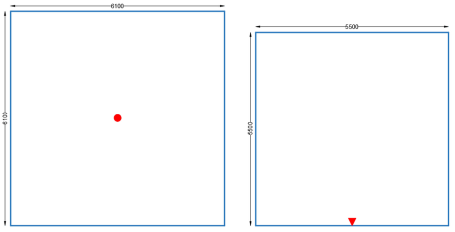
However, the maximum distance from any room wall to the pendent sprinkler cannot exceed half of the listed head spacing (S/2). Given our listed coverage width of 6.1 m, the maximum allowable distance to any perimeter boundary is 6.1 m / 2 = 3.05 m. Since the room's longest dimension remains within this boundary, Option 3 successfully protects the space using one pendent head.
Sprinkler Placement Calculations for Bedroom 2
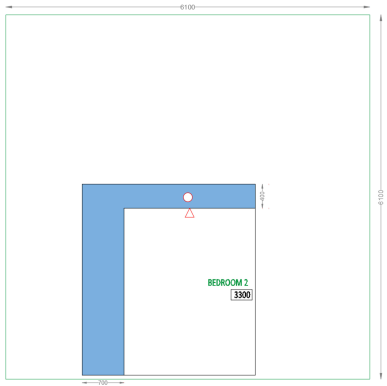
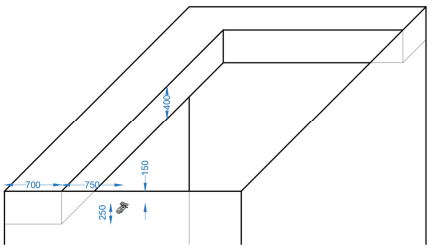
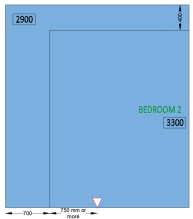
Bedroom 2 features an asymmetric layout with two perimeter soffits: a northern soffit measuring 400 mm wide and a western soffit measuring 700 mm wide. The ceiling pocket rule cannot be applied here because the soffit drop depth is 400 mm, which exceeds the allowable 300 mm limit.
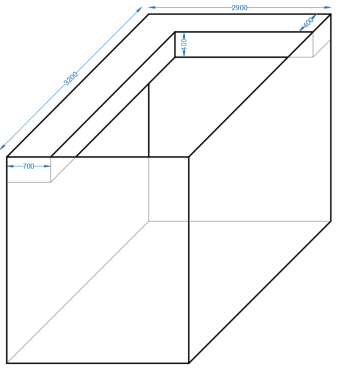
Option 1: Mounting a Sidewall Sprinkler on the Face of the West Soffit
Mounting the head on the western soffit face causes the perpendicular northern soffit to act as an adjacent obstruction. We apply the NFPA 13 adjacent soffit criteria:
- Soffit Width ≤ 600 mm: The adjacent obstruction is ignored under Section 8.10.7.1.4(4).
- Soffit Width > 600 mm up to 800 mm: Spacing must comply with the clearance formula A ≥ (D - 200 mm) + B.
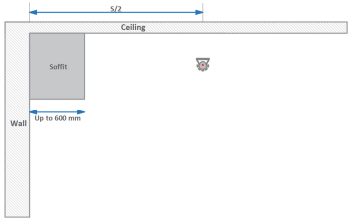
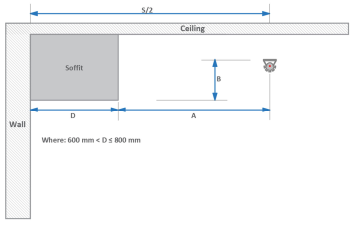
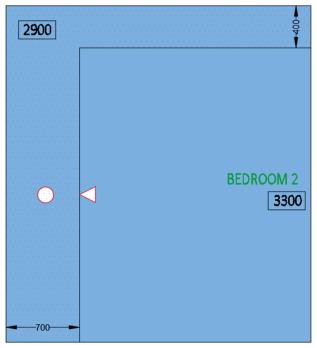
Because the adjacent northern soffit is 400 mm wide, it falls below the 600 mm limit and is ignored as an obstruction. However, under Section 8.10.7.1.5.1, the 700 mm wide western soffit located behind the head requires a dedicated pendent sprinkler underneath. This option requires two sprinkler heads.
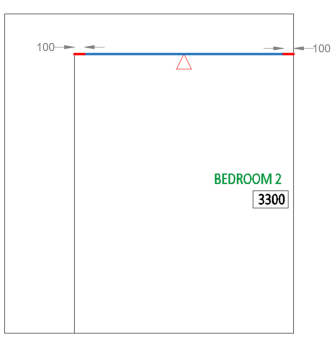
Option 2: Mounting a Sidewall Sprinkler on the Face of the North Soffit
Mounting the head on the northern soffit face causes the 700 mm wide western soffit to serve as the adjacent obstruction. Because the northern soffit is 400 mm wide, a pendent sprinkler is already required underneath it.
A key engineering principle of NFPA 13 is that this required pendent head can protect all contiguous soffit areas at the same elevation within its nominal coverage area. The pendent head's listed 6.1 m × 6.1 m coverage footprint fully encompasses the undersides of both the northern and western soffits. This removes the western soffit as an obstruction for the sidewall sprinkler, resulting in a flexible mounting line for the sidewall head.
Option 3: Mounting a Sidewall Sprinkler on the Shared South Wall
Routing the branch line above the WIC's suspended ceiling allows us to mount a sidewall head on the south wall throwing north. This option introduces two distinct obstructions:
- North Soffit (Front Obstruction): Width is 400 mm and depth is 400 mm. Because both values are ≤ 600 mm, it is completely ignored per Section 8.10.7.1.6.
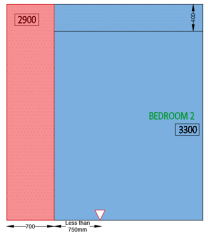
- West Soffit (Adjacent Obstruction): Width is 700 mm. Because this width falls between 600 mm and 800 mm, we must calculate the required horizontal clearance using the adjacent soffit formula: A ≥ (D - 200 mm) + B.
Given a total soffit drop depth of 400 mm and a maximum listed ceiling-to-deflector distance of 150 mm, the dimension B is: 400 mm - 150 mm = 250 mm. We substitute these values into the clearance formula:
If the sidewall sprinkler is mounted closer than 750 mm to the western soffit face, the soffit acts as an obstruction and creates an unprotected dry area. If the head is positioned at least 750 mm away from the western soffit edge, the spray pattern clears the obstruction and covers the room with one single head.
Sprinkler Placement Calculations for Bedroom 3
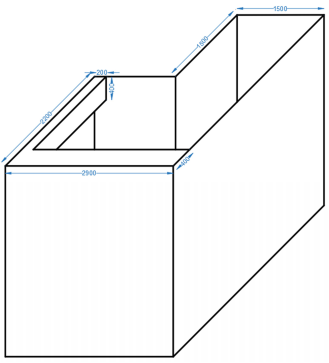
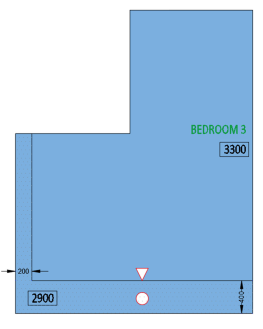
Bedroom 3 includes a 200 mm wide western soffit and a 400 mm wide southern soffit. The intersecting partition wall layout introduces potential hydraulic shadow zones.
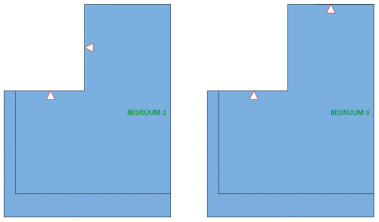
Option 1: Mounting a Sidewall Sprinkler on the Face of the South Soffit
Because the southern soffit is 400 mm wide, Section 8.10.7.1.5.1 requires an additional pendent head underneath it. The western soffit is only 200 mm wide, so it is ignored as an obstruction under the code. This design option requires two sprinkler heads.
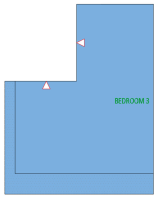
Option 2: Mounting a Sidewall Sprinkler on the Face of the West Soffit
Because the western soffit is only 200 mm wide, it does not require a pendent head underneath. Additionally, the southern soffit is ≤ 600 mm wide and can be ignored as an obstruction per Section 8.10.7.1.4(4).
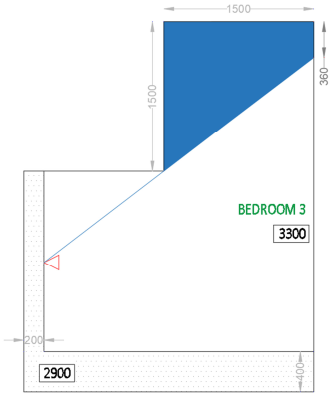
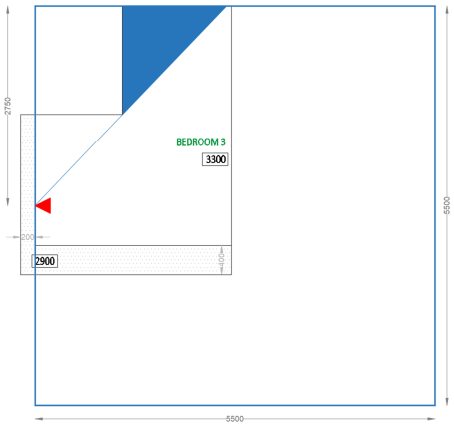
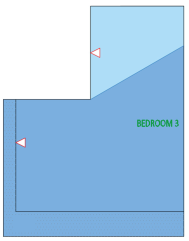
However, mounting a head here causes the partition wall between Bedroom 3 and the closet to cast a geometric shadow zone across the northern area of the room. While the 2016 edition of NFPA 13 does not define an upper limit for shadow areas, relevant residential codes restrict the maximum allowable shadow area from a single head to 1.4 m² (15 ft²).
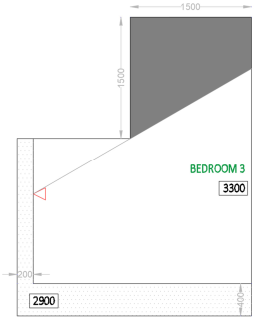
We calculate the shadow zone using the geometric formula for a trapezoid: Area = [(B1 + B2) × Height] / 2. Given B1 = 1.5 m, Height = 1.5 m, and Area = 1.4 m², we solve for the maximum allowable length of the shadow side B2:
To chart this on the contract drawings, layout technicians measure a 360 mm segment along the eastern wall starting from the northeast corner. Extending a boundary line from this point through the partition wall corner intersects the western soffit face to define the compliant installation zone. Moving the sprinkler north of this calculated point expands the shadow zone beyond the 1.4 m² limit, while moving it too far south violates the maximum wall-to-sprinkler spacing rule. To protect Bedroom 3 using only one sprinkler head, the installer must mount the sidewall sprinkler precisely along the calculated line.
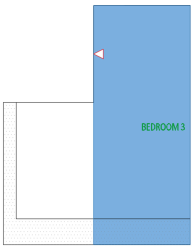
Options 3 & 4: Mounting on Intermediate Closets and Partition Assemblies
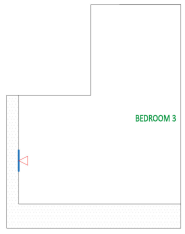
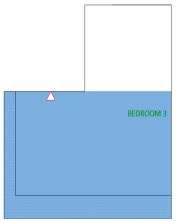
Mounting the sidewall head on the intermediate walls leaves sections of the room unpopulated and out of reach of the spray pattern. To restore full coverage, a second sidewall sprinkler must be added to the opposite wall. While the second head throws a shadow that exceeds 1.4 m², this is acceptable because the primary head covers the shadowed area.
Option 5: Mounting a Sidewall Head on the Shared Bathroom Wall Partition
This option mirrors the shadow calculation used in Option 2. The head must be aligned with the calculated boundary line to avoid casting an excessive shadow zone to the left or violating maximum wall-to-sprinkler spacing to the right per Section 8.10.4.6.1.
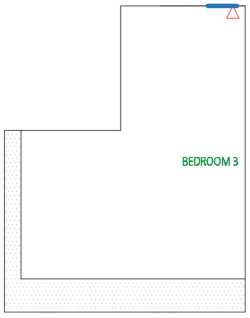
Sprinkler Placement Calculations for the Great Room & Service Areas
Great Room Spacing Options
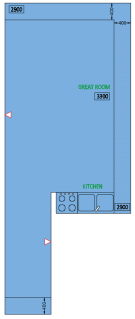
The Great Room contains three perimeter soffits along its northern, eastern, and southern corridor runs.
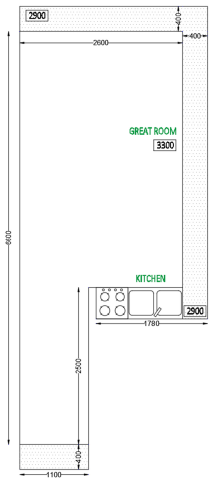
- Options 1 & 2: Mounting sidewall sprinklers on the face of the 400 mm wide eastern and southern soffits requires adding secondary pendent heads underneath them. This configuration uses a total of four heads (two sidewalls and two pendents).
- Option 3: Mounting sidewall heads on the shared walls of the bathroom and closet allows the spray pattern to bypass the soffits. This option protects the entire space using only two sidewall heads. To prevent cold soldering, the heads must be positioned so their spray patterns do not discharge directly onto each other per Section 8.10.3.4.
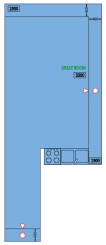
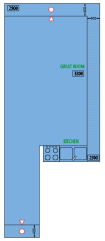
Service Area Layouts (WIC, Bathroom, Laundry, Closets)
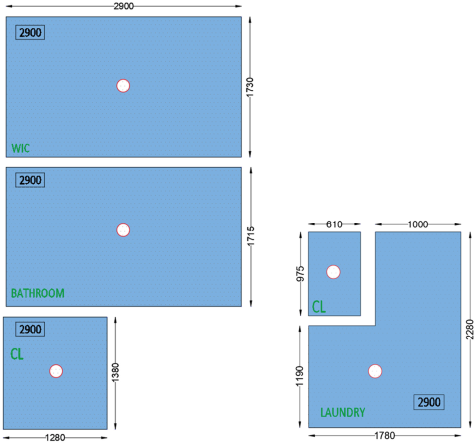
Because these auxiliary rooms feature suspended ceilings, they are protected using hidden branch lines and residential pendent sprinklers. Due to the small room sizes, a single pendent head per space provides adequate coverage. In the laundry room, the head position must be calculated to prevent shadow zones behind appliances.
Part 4: Final Optimized Design Selection
By comparing the layout options, we establish an optimized design that minimizes material requirements, pipe lengths, and labor costs while maintaining strict code compliance.
| Room Designation | Minimum Required Sprinklers | Chosen Design Configuration |
|---|---|---|
| Bedroom 1 | 1 Head | 1 Sidewall Sprinkler (Option 2 Setup) |
| Bedroom 2 | 1 Head | 1 Sidewall Sprinkler (Option 3 Setup) |
| Bedroom 3 | 1 Head | 1 Sidewall Sprinkler (Option 2 Setup) |
| Great Room | 2 Heads | 2 Sidewall Sprinklers (Option 3 Setup) |
| Walk-In Closet (WIC) | 1 Head | 1 Pendent Sprinkler Drop |
| Bathroom | 1 Head | 1 Pendent Sprinkler Drop |
| Laundry | 1 Head | 1 Pendent Sprinkler Drop |
| Corridor Closets | 2 Heads | 2 Pendent Sprinkler Drops (1 per Closet) |
Part 5: Obstruction Criteria for Pendent and Upright Sprinklers
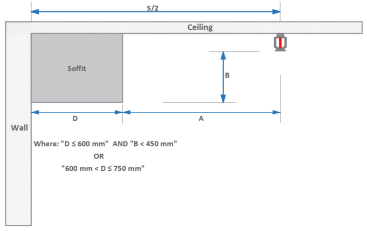
Where residential pendent or upright sprinklers are positioned near structural obstructions, spacing must comply with standard clearance rules. If water can pass beneath the obstruction, designers apply the standard Beam Rule per Table 8.10.6.1.2 and Figure 8.10.6.1.2(a). For soffits or beams running flat against a perimeter wall, NFPA 13 provides specific upright/pendent Soffit Rules:
Soffit Profile 1: Width Up to 600 mm and B μ 450 mm
If the soffit width is 600 mm or less, and the vertical distance from the deflector to the bottom of the soffit (B) is 450 mm (18 inches) or greater, the soffit is ignored as an obstruction under Section 8.10.6.1.2(4). No additional protection is required beneath it.
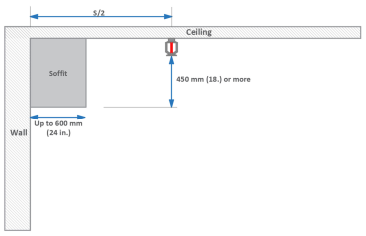
Soffit Profile 2: Width Up to 750 mm
If the soffit width is 600 mm or less but the vertical distance B is under 450 mm, or if the soffit width falls between 600 mm and 750 mm (30 inches), placement must comply with Section 8.10.6.1.2(3). The head must maintain the horizontal clearance defined by the formula: A ≥ (D - 200 mm) + B.
Part 6: Computer-Aided Design and Layout Software Integration
Modern fire protection engineering relies on software tools to automate layout compliance. The Sprinkler Layout App within the NSVCad software platform provides a tool for verifying compliance with NFPA 13, 13R, and 13D criteria.
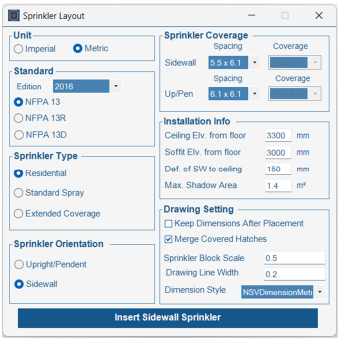
Software Automation Features:
- Dynamic Coverage Mapping: The software displays covered areas in blue and unpopulated or obstructed zones in red, updating in real time as heads are moved.
- Soffit Rule Verification: Automatically calculates front, rear, and adjacent soffit clearance parameters based on the selected sprinkler model.
- Shadow Area Evaluation: Calculates geometric shadow zones cast by partition walls. If a shadow zone exceeds the 1.4 m² (15 ft²) limit, the display color changes from blue to red to signal a code violation.
- Automatic Head Placement: Automatically places a pendent head underneath any soffit wider than 200 mm when a sidewall head is mounted to the soffit face.
- Clearance and Proximity Alerts: Prevents users from placing heads closer than 100 mm to walls or within the listed proximity of adjacent sprinklers.
Technical Summary Matrix: NFPA 13 Soffit and Obstruction Rules
| Soffit Orientation relative to Sidewall Head | Obstruction Dimension Parameter | Required Engineering Action / Rule Compliance |
|---|---|---|
| Soffit Behind Sprinkler (Head mounted on face) | Width Up to 200 mm | Soffit can be ignored; no additional sprinkler required underneath. |
| Soffit Behind Sprinkler (Head mounted on face) | Width Over 200 mm | Dedicated pendent sprinkler must be installed underneath the soffit. |
| Soffit In Front of Sprinkler (Throwing toward it) | Width & Height Up to 600 mm | Soffit can be completely ignored as a spray obstruction. |
| Soffit In Front of Sprinkler (Throwing toward it) | Width or Height Over 600 mm | Apply the standard Beam Rule. If clearance is insufficient, add a head underneath. |
| Soffit Adjacent to Sprinkler (Parallel run side) | Width Up to 600 mm | Soffit can be completely ignored as an adjacent obstruction. |
| Soffit Adjacent to Sprinkler (Parallel run side) | Width Over 600 mm up to 800 mm | Apply clearance formula: A ≥ (D - 200 mm) + B. Add a head if failed. |
| Soffit Adjacent to Sprinkler (Parallel run side) | Width Over 800 mm | Apply the standard Beam Rule. If clearance is insufficient, add a head underneath. |
FAQ
Does increasing pipe size reduce fire sprinkler hydraulic demand?
Yes. Increasing the internal diameter of fire sprinkler piping decreases the velocity of the water, which reduces friction loss as calculated by the Hazen-Williams formula. Lower friction loss preserves pressure within the network, reducing the total pressure demand required at the system riser or source pump.
What is the maximum allowable shadow area for a residential fire sprinkler?
Under modern residential standards, including NFPA 13R, NFPA 13D, and updated editions of NFPA 13, the maximum allowable shadow area cast by an architectural wall partition or column is 1.4 m² (15 ft²) from a single head. Any shadow zone exceeding this threshold requires an additional sprinkler head to ensure complete coverage.
When does a structural soffit require a dedicated sprinkler head underneath it?
Per NFPA 13, if a residential sidewall sprinkler is mounted directly onto the face of a structural soffit, a dedicated pendent sprinkler must be installed underneath the soffit if its width exceeds 200 mm (8 inches). For soffits positioned in front of or adjacent to the head, dedicated protection is required only if the dimensions violate the 600/800 mm clearance rules or the Beam Rule.
How does operating pressure affect the coverage area of a residential fire sprinkler?
Unlike standard commercial spray sprinklers that have fixed maximum coverage areas regardless of pressure, a residential fire sprinkler's maximum coverage area is a direct function of its operating pressure. As defined by manufacturer listings, a head may cover a 3.7 m × 3.7 m area at 7 psi, but can expand to cover up to a 6.1 m × 6.1 m area if system pressure is increased to 17 psi.
What is the difference between the Beam Rule and the Soffit Rule in NFPA 13?
The Beam Rule applies to structural obstructions located in the open field of a room's ceiling layout where water spray can pass around both sides. The Soffit Rule applies specifically to obstructions running flat against a perimeter wall. Because walls inherently limit the spray profile, the Soffit Rule provides more relaxed clearance requirements than the Beam Rule.
Can a single pendent sprinkler protect a recessed ceiling pocket without heads inside it?
Yes, under the NFPA 13 Ceiling Pocket Rule. A single pendent sprinkler can protect an adjacent recessed ceiling pocket if the pocket's maximum depth does not exceed 300 mm (12 inches), its total volume remains under 2.8 m³ (100 ft³), the interior surfaces are noncombustible, and the head remains within the maximum allowable half-spacing (S/2) distance from all walls.


No comments yet. Be the first to share your thoughts!